

Every serving dish I have ever regretted buying had one thing in common. It looked better on a screen than it worked on a table. I have bought shallow bowls a spoon could not get into, platters so wide they pushed the salt and pepper off the tablecloth, and one handsome piece that chipped the first time a serving fork touched it. I taught home economics for the better part of three decades and I still got fooled. So I would rather tell you the things a product page leaves out, because the difference between a dish you use twice a year and one you reach for every Sunday is almost always in a detail nobody photographs.
The MORA oval platters are a set of two ceramic serving dishes, 13.5 inches and 11.8 inches long, holding 55 and 35 ounces. They are oval, they are oven safe and dishwasher safe, and the glaze is the glossy crystallized kind the company says will resist scratching under pressure. What the listing never quite explains is how those numbers behave in a real dining room with twelve people and a card table jammed at the end of it.
That is the part I can speak to, because these have been on my table since early spring. They have been through a Sunday dinner most weeks, a birthday supper for eleven, and a full holiday run-through in October when I cooked the whole menu a month early just to see how my dishes would behave under pressure. Here is what I found, including the parts that would make me hesitate.
The Quick Verdict
Honest, useful serving pieces for a hostess who serves food with some body to it. Shallow enough that anything juicy will slosh on the carry, and the small one holds less than the photograph suggests.
Amazon Check Today's Price →Look at both sizes side by side before you plan a menu around them
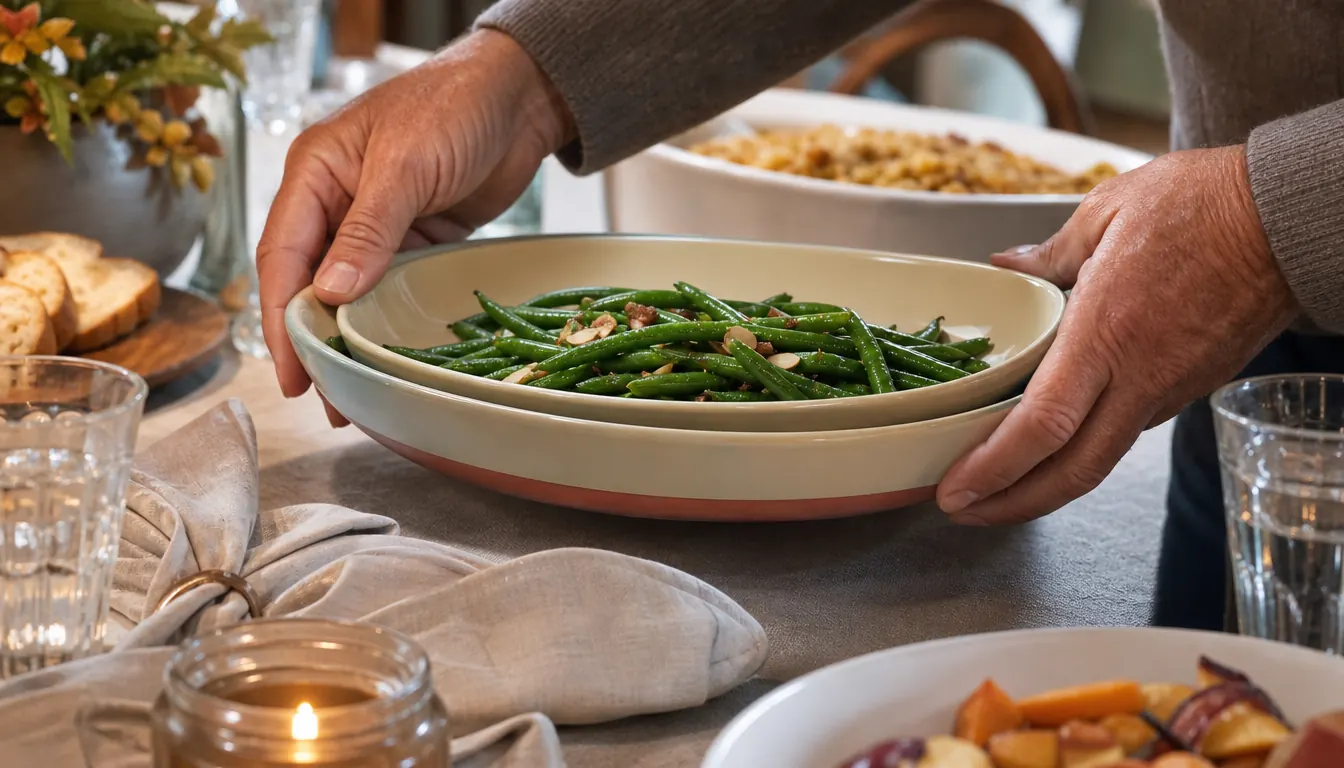
The 13.5 inch platter and the 11.8 inch one do very different jobs at a table for eight. The difference decides whether your side dish fits or moves to the sideboard.
Amazon Check Today's Price on Amazon →What Nobody Tells You Before You Buy
Start with the number that is easiest to skim past. The larger platter is 2.2 inches high. That is not a bowl depth, it is a platter depth, and that single measurement decides most of what you can and cannot do with these. A dish of roasted carrots, a sliced pork loin, a pile of rolls, a fruit assortment, all of that works beautifully. A salad dressed twenty minutes before dinner, or anything that gives up its juice as it sits, does not.
The second thing is capacity. Fifty-five ounces is the larger platter and thirty-five is the smaller, and thirty-five reads bigger on a screen than it feels on a table. In my kitchen that smaller dish holds a generous serving of green beans for six people and a thin one for twelve. If you plan your menu around the small one being a side dish and the large one being the main event, you will be perfectly happy. If you buy the set expecting two main-dish platters, you will not be.
The third thing is what is not in the box. There is no lid and no carrier. These are not the dishes you load into the car for a church potluck, and I would not try it. They are the dishes that go from the oven to the table and then to the sink, which is a different job entirely. Knowing that up front saves you from buying them for the wrong reason and then being disappointed by a piece that is doing exactly what it was made to do.
The fourth thing is the one I would tell a friend to do before ordering anything for a table. Take a tape measure to your own dining table and mark 13.5 inches along the center line, then lay a dinner plate on either side of the mark. That is what the large platter costs you in real estate. On my oak table with both leaves in, 13.5 inches still leaves room for eight place settings plus the salt and pepper, but not much else. I did that exercise with a piece of newspaper cut to size before I ordered, because a few years back I bought a wide round bowl that fit the table fine and made the table useless. Newspaper is cheaper than a return, and it takes about four minutes.
What the Listing Actually Gets Right
I have been hard on the description, so let me be fair to the dish. The oval shape is the best decision in the whole design. A round bowl of the same capacity takes up the front-to-back space of a dinner plate and then some, and it forces everything else to rearrange around it. An oval slides between the vegetable dish and the bread basket in a way a circle simply cannot. On a table with both leaves in, that matters more than any other feature.
The two-size set is the second thing they got right, and I do not think a shopper appreciates it until the first crowded meal. One platter for the main dish and one for the salad, and both of them plain enough to sit beside my everyday dishes without looking like they arrived as a matched set from a catalog. The surface is solid with no pattern fighting the tablecloth, which sounds like a small thing until you have set a table where three patterns were already arguing.
How These Have Actually Been Used at My Table
Sunday dinner at our house is six people most weeks, sometimes eight when both leaves go in. The small platter carries the salad, which I assemble just before we sit so the dressing does not pool in the bottom, and the large one carries whatever the main dish is. My husband Walt does the dishes afterward, and he has never once complained about either piece, which is its own kind of review coming from a man who has opinions about cookware.
The first real test came on a Sunday in April, the week after they arrived. I served a pork loin, which I had been nervous about, because the loin was long and I did not think it would lie flat in an oval dish. It did, with room at both ends, and I slid the whole thing off the roasting pan and onto the platter without cutting it in half first. Before the MORA platters I was cutting loins in two and stacking the halves, which dries out the bottom piece by the time anyone reaches it. That is a small thing. It is also exactly the kind of small thing that changes how you cook for company without your quite noticing.
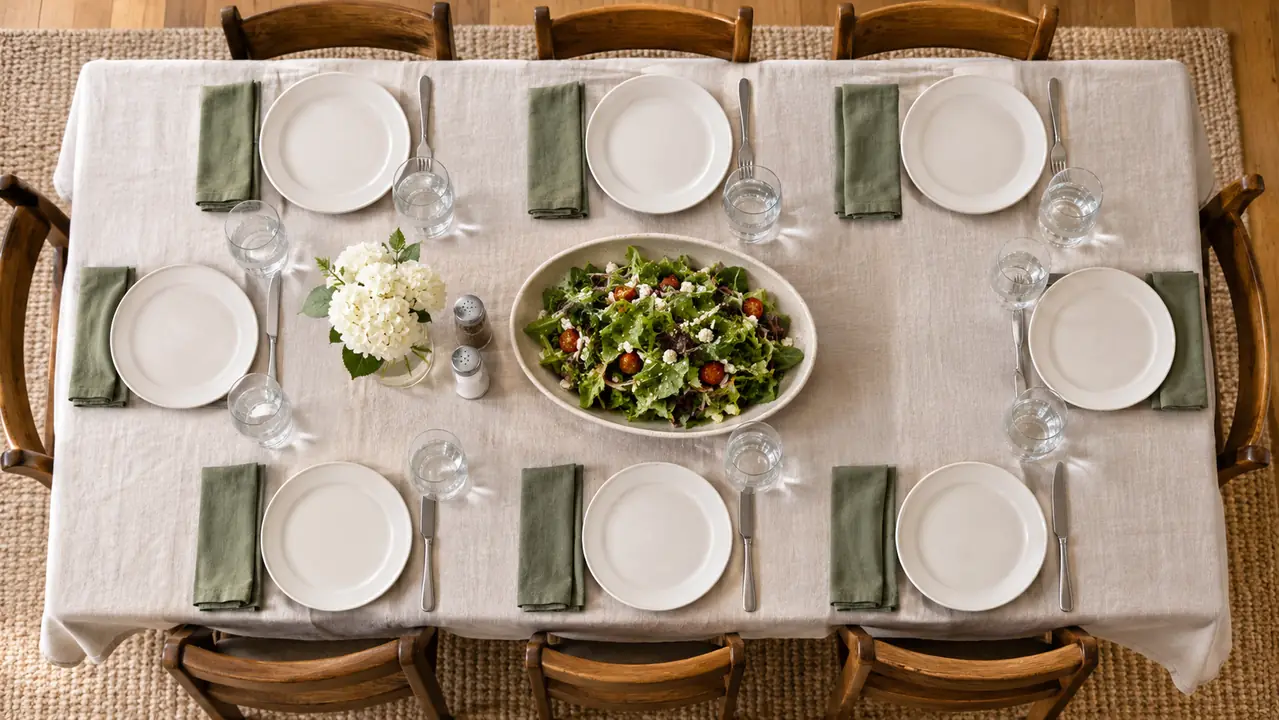
The holidays are the real test. We run twelve to fourteen, with a card table added at the end, and every dish has to be on the table at once. The 13.5 inch platter took the sliced turkey and it sat among eight place settings without touching a single water glass. I watched it all through dinner to be sure. The smaller platter in that same spot would have forced me to move the cranberries to the sideboard, and moving the cranberries means somebody at the far end does not get any.
I also use the larger one in a warm oven, not a hot one, to hold rolls until the table is ready. It goes in at low heat and comes out without a fuss, and the glaze has not clouded or crazed from it. On a normal week I reach for one or both of them three or four times, which is far more than I can say for the good china in the hutch.
The 13.5 inch platter held the sliced turkey at a table of twelve without touching a single water glass. The 11.8 inch one would have pushed the cranberries to the sideboard.
The Two-Inch Depth Problem
I want to be plain about the shallow depth, because it is the one thing that would send these back for some shoppers. When you lift a platter with any liquid in it, the liquid moves. A dressed salad that sits through a long blessing will leave a puddle, and carrying that puddle across the kitchen takes two hands and a slow walk. I have done it. Nothing spilled. But I was paying attention, and I do not want to pretend otherwise.
The day I learned that lesson properly was a Saturday in June when I dressed a spinach salad with a warm bacon dressing about ten minutes before we sat down. By the time the plates made it around, there was a pool of dressing across the bottom of the small platter and the spinach near the middle had gone limp. Nobody complained and the salad was eaten to the last leaf. But I have not repeated it. Now the dressed salad goes into a deep stoneware bowl, and the platters carry undressed greens, sliced tomatoes, cornbread, or anything else that can look at a little juice without drowning in it.
The trade is worth it to me. A deep bowl will not let you spread a whole roasted chicken or lay out a fan of sliced pork without stacking the pieces on top of each other. A deep bowl also hides the food from the far end of the table, and half the pleasure of a holiday table is seeing what is on it before you get there. A shallow oval shows everything at once. That is why restaurants serve this way, and it is why I keep reaching for these.
If your family's favorite dishes are stews, gravies, or anything that comes to the table with a ladle, buy one deep bowl for those and use these for everything else. I keep a stoneware bowl for the pot roast and its juices, and I have never once wished the MORA platters were deeper while the pot roast was on the table. I only wish it when I am carrying salad.
What I Liked
- Two genuinely different sizes, so one dish does two jobs at the same meal
- Oval shape fits a crowded table better than a round bowl of the same capacity
- Glossy glaze has not scratched after months of serving forks and metal spatulas
- Oven safe, so it goes from warming rolls to the table without a second dish
- Dishwasher safe on the weeks I do not hand wash
- Solid surface sits quietly beside everyday dishes without competing with the tablecloth
Where It Falls Short
- Only 2.2 inches deep, so anything with juice needs a different piece
- The 35 ounce platter is small for a crowd of twelve
- No lid and no carrier, so it stays home
- Oval takes more room front to back than a round bowl, which matters on a narrow table
Glaze, Care, and the Dishwasher
The company makes a specific claim about the glaze, that it resists scratches under a thousand grams of pressure. I cannot verify a number like that in my own kitchen, and I would be skeptical of anyone who says they did. What I can tell you is what I have done to it. I have dragged a metal serving fork across the bottom of the large platter more times than I should admit, and scraped at a stuck piece of roast with a metal spatula. I held it up to the window afterward. No marks I can find.
That stuck piece of roast deserves the whole story, because it is the honest test I actually ran. It was a chuck roast in February, cooked low and slow, and a corner of it caramelized onto the platter and set hard while I was in the other room taking the bread out. I soaked the dish in warm water for maybe five minutes, then went at the corner with a metal spatula, pressing hard, the way you do when you are not thinking about the finish on a serving piece. The MORA platter came out clean and I have looked at that spot in daylight since. I do not recommend treating a dish that way. I mention it because a review that only describes the gentle handling is not telling you much.
The dishwasher question is simpler than people make it. Both pieces are listed as dishwasher safe and I have run them through without a problem. Most weeks I hand wash the large one anyway, because it takes about as long to wash as it does to load, and I would rather have it back in the hutch where I can see it. That is habit, not necessity, and I would not want you to think the machine damaged anything.
For storage I keep both platters standing on edge in the glass-front hutch, which is where the pieces I actually use live. The everyday dishes are in the kitchen within arm's reach and the good china is on the top shelf gathering dust, and these sit in between. That placement tells you more about how I feel about them than any rating could.
What I Would Change
If I could sit down with the people who make these, I would ask for one thing. A deeper version of the large platter, a half inch more, for the dishes that give up juice. Everything else I would leave alone. The proportions are right, the two sizes are right, and the plain surface is right for a table that already has a patterned cloth and a centerpiece competing for attention.
I would also tell them to put the depth in the first line of the listing. It is the number a hostess needs and it is buried under descriptions of clay strength. That is not a complaint about the dish. It is a complaint about how the dish is described, which is the whole reason I am writing this down for you instead of keeping it to myself.
Who This Is For
This is for the hostess who serves food with some body to it. Roasts, sliced meats, roasted vegetables, rolls, fruit, a salad assembled at the last minute. It is for a table that is crowded and needs dishes that slide between place settings instead of taking over the middle. It is for someone who wants a serving piece that looks like it belongs with her everyday dishes rather than announcing itself as a set. And it is for anyone who has been quietly irritated by how much room a round bowl eats up on a table that seats eight.
Who Should Skip It
Skip it if your signature dish is a wet one. Skip it if you regularly cook for fifteen and need a single dish to hold all of the green beans, because the smaller platter will not do it and the larger one is a main dish, not a side. Skip it if you need to carry food in the car, since there is no lid. And skip it if what you actually want is a covered casserole that travels from oven to refrigerator to table, because that is a different piece of equipment and you will be happier buying the thing you truly need than making this one do a job it was never built for.
The 13.5 inch platter is the one that earns its place
If you are setting a table for eight or more, the larger size is the one that will not crowd your place settings or push the sides off to the sideboard.
Amazon Check Today's Price on Amazon →