

Sixty-five pieces sounds like plenty of silverware until you are standing at the kitchen counter at ten o'clock on a Sunday night, counting salad forks to work out whether the twelfth one went home in somebody's leftovers. That is how I came to know the Mikasa Satin Loft set better than I intended to. I taught home economics for twenty-seven years before I retired, and I have set a table most nights of my life since. Sunday dinner happens at my house most weeks, and Thanksgiving and Christmas run twelve to fourteen people with a card table pushed up against the end of the oak table. My opinions about forks were earned one dinner at a time, not borrowed from a catalog.
This will not be a review that tells you everything is wonderful. The set is good. It has lived in my china hutch and my kitchen drawer for two years, it has been through the dishwasher more times than I could count, and I would buy it again. But there are several things about it that no listing photograph will show you, and if you are buying a service for twelve, you deserve to hear them before the box arrives rather than after the return window closes. So here is what I actually found, roughly in the order I found it, along with the parts I would change if somebody handed me the design pencil.
The Quick Verdict
A genuinely comfortable service for twelve that holds up to weekly family dinners and a hot dishwasher. Buy it for the feel in the hand and for everyday work, not for heirloom dreams.
Amazon Check Today's Price →The set that has been in my drawer for two years
Sixty-five pieces, service for twelve, 18/10 stainless steel, dishwasher safe, and a satin finish that does not hold fingerprints. Check today's price and the recent reviews on Amazon.
Amazon Check Today's Price on Amazon →How I've Used It, and How Hard I've Been On It
The set went into service the week it arrived and has not had a day off since. Twelve places on Sunday, eight on a weeknight when it is just Walt and me and whichever grandchild has decided that Grandma's house has better bread. That is the sort of use that finds every weak point in flatware. A fork that bends a little gets bent the rest of the way within a month. A knife handle with a seam in it starts holding water, and then it starts smelling like the inside of a thermos. I have thrown out two sets in my life for exactly those reasons, and I was watching this one for the same signs from the first week.
Out of the box, the pieces felt better balanced than I expected, because the weight sits where your fingers actually go instead of in a thick, heavy handle. I washed them by hand that first night out of habit, dried them on a towel, and set eight places for supper. Walt picked up a fork and said, without being asked, that these felt better than the ones we had. Walt does not comment on flatware. That was the first review this set got in this house.
Two years in, none of my worries have come true. The dinner forks have no bend in them, and my son-in-law is a big man who eats like the meal is a competition. The handles have no seam I can find with a fingernail, and nothing in the drawer has gone black or spotted. Eight pounds is the weight of the whole sixty-five pieces, which tells you something about the gauge. These are not the thick, heavy-handed restaurant pieces that feel like a small hammer, and they are not the thin ones that flex when you cut a pork chop. They sit in the middle, and for a household like mine the middle is the right place to be.
Thanksgiving is the real test. Fourteen people, two tables, three dishwasher loads before midnight, and a sink full of serving dishes in between. A set comes out of a holiday either intact or with a bent fork and a knife somebody dropped on the tile. This one has come out intact two years running. I have not had to sort through the pieces afterward and set anything aside. That is a plain sentence, but it is the whole reason I am writing this.
The finish is what I notice most, and it is the reason I have kept using these rather than rotating them out. The satin sheen does not hold fingerprints the way a bright, glassy surface does. When I set twelve places and then carry a platter in from the kitchen, I am not leaving a trail of smudges on every handle. Anyone who has set a holiday table knows exactly why that matters. You do not want to be wiping down the flatware with a dish towel thirty seconds before you say grace.
What the Listing Photographs Don't Show You
First, the flat handle shape feels different in the hand than it looks in a picture. On a screen, a flat handle reads as plain, maybe even a little severe. In use, that flatness is what makes the set comfortable. There is no ridge digging into the base of your finger when you hold a fork the way you were taught. My mother's wedding silver had a raised pattern down the handle, and after a long Thanksgiving dinner your hand knew it. Mine never does with these.
Second, the balance is right in a way you cannot judge from a product page. A dinner knife that is too light at the handle end will tip forward off the rim of a plate and land in somebody's lap. I have watched that happen at other people's tables, and there is no graceful recovery. The Satin Loft knife sits flat on the plate edge without tipping. It is a small thing that will save you an embarrassing moment in front of your mother-in-law.
Third, the sizes are sensible for real food. The dinner fork is big enough for a slice of ham without the tines looking strained. The salad fork is genuinely smaller and not just a dinner fork with a shorter handle. The teaspoons are teaspoons. That sounds like nothing, and yet I have used sets where every piece was the same size with a different name on it, and eating a bowl of soup with a shovel is not a pleasant experience.
Fourth, the arithmetic of the set surprises people. Twelve dinner forks, twelve salad forks, twelve dinner knives, twelve dinner spoons and twelve teaspoons make sixty. The five pieces left over are the serving pieces, and they are the ones that get borrowed. I have had more than one daughter-in-law ask to take the serving spoon home. The set covers twelve places completely, which sounds obvious until you host fourteen and realize you were counting on those five extras to help fill in at the card table.
Eight pounds across sixty-five pieces tells you the gauge: not restaurant heavy, not flimsy, and right in the middle where a family table wants it.
Where It Falls Short
Now the part the listing will not say. These are not heirloom pieces, and you should not buy them expecting to hand them to a granddaughter. 18/10 stainless steel with a satin finish is a very good everyday material. It is not sterling, and forty years from now it will look like a well-kept set of everyday flatware rather than an inheritance. If you want the set that gets divided up after you are gone, this is not that set. Buy it knowing that and you will be perfectly happy with it. Buy it expecting the other thing and you will be disappointed by year three.
The flat handles cut both ways at a formal table. They are comfortable and they are easy to keep clean, but they are plain. My mother's china has a gold rim and a scalloped edge, and these look a little country next to it. That is a matter of taste, not a defect, and I have decided I do not mind. But if you are setting a table for a wedding reception or a church supper, with the good cloth and the good china and the candles lit, you may find yourself wishing for a handle with a little more decoration on it.
Because the pieces are plain and identical, they wander. Not into thin air, but into other people's kitchens. A teaspoon goes home in a purse without anyone meaning for it to. A salad fork ends up in a casserole dish that gets returned three weeks later, washed, with a thank-you note. With a patterned set you can spot a stray piece across the room. With this one you are counting at the end of the night like a teacher taking attendance, which is exactly what I do, and I am not ashamed of it.
One more small complaint. The set does not photograph especially well, and I think that has cost it some buyers. On a table it looks calm and comfortable. Flattened against a white background in an online listing, it looks like what it is: good plain flatware. There is nothing wrong with that, but you should know that the thing you are buying is better than the picture of it, which is the reverse of most of what arrives in a box these days.
What I Liked
- Comfortable through a long dinner, with no ridge digging into the base of your finger
- Satin finish resists fingerprints, so a set table stays presentable
- Handles have no seam, so nothing traps water or holds an odor
- 18/10 stainless steel, dishwasher safe, two years in with no rust, spotting or dulling
- Sixty-five pieces cover twelve places and add five serving pieces
- Knives balance flat on the plate edge instead of tipping into a lap
Where It Falls Short
- Not heirloom weight or heirloom looks. This is everyday flatware
- Plain handles read casual beside formal china with a gold rim
- Identical pieces wander home with guests, so you will count at the end of the night
- The serving pieces are the first to be borrowed and the last to come back
- Sixty-five pieces need more drawer space than most organizers give

Living With It: Care, Storage and the Counting Problem
The Mikasa set is dishwasher safe and it lives in my dishwasher. I do not hand wash flatware and I do not believe anyone who claims to on a Tuesday. Two years of that has not dulled the satin sheen or left water spots that would not wipe off with a thumb. I do run the drying cycle rather than pulling the pieces out wet, because wet stacking is what leaves marks on any stainless steel, and I am not going to blame a manufacturer for a habit of mine. If your machine has a heated dry, use it.
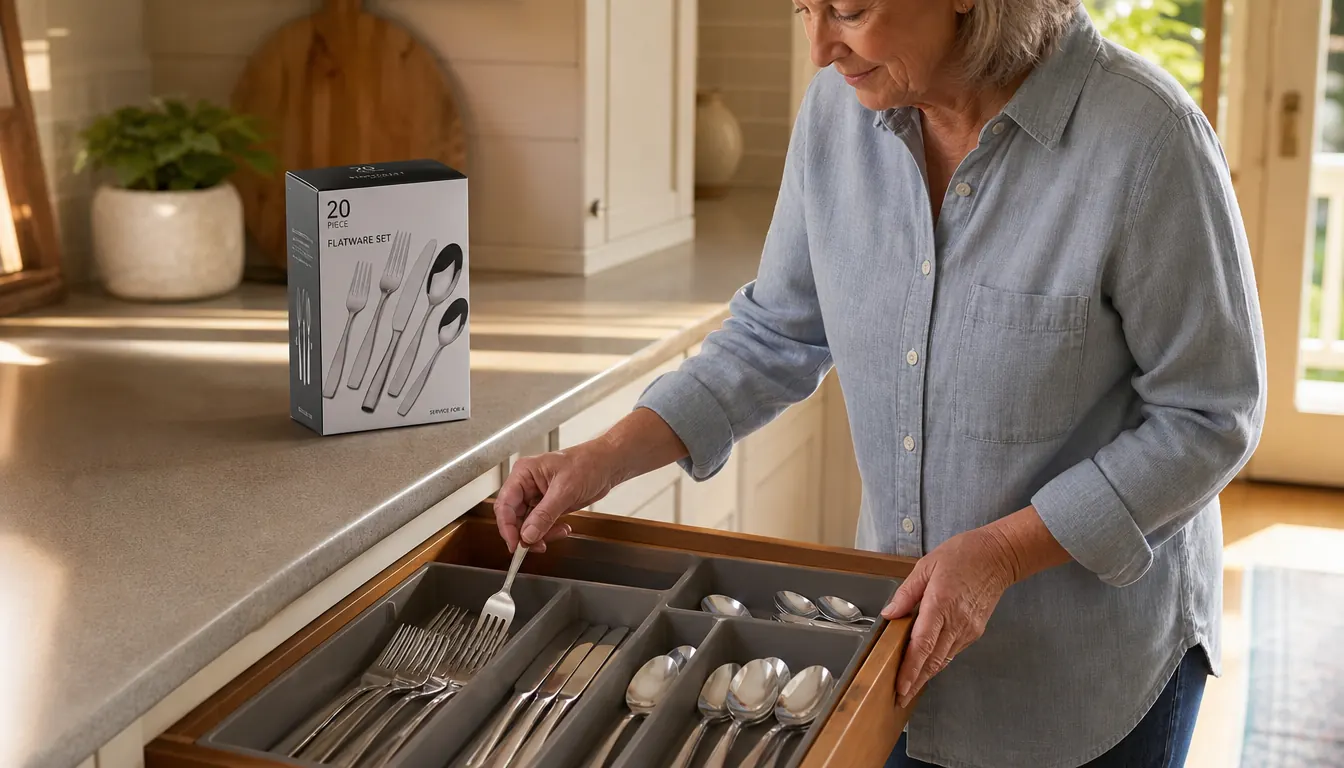
Storage takes more room than people expect. Mine are in a divided flatware organizer in the kitchen drawer, loose, not in a chest. Sixty-five pieces is more than most organizers will hold comfortably, so the serving pieces live in a small crock in the hutch and the extra teaspoons live in a zip bag in the buffet. If you intend to keep the whole set in one place, plan for that now rather than discovering it the day the box arrives.
A holiday wash load is worth describing. Three dishwasher runs in one night, hot water, and the pieces going straight from the machine back into the organizer while people are still at the table with their coffee. Nothing has warped and nothing has discolored. I have had cheap sets come out of a hot cycle with a dull, cloudy look that never came back. This one looks the same in December as it did in July.
Guests notice the feel more than the look, which is the reverse of how most table things work. I have had two people pick up a dinner fork at Sunday dinner and turn it over in their hand to look at the back of it. Nobody has ever turned over a plate. If you are the sort of hostess who takes pleasure in the small comforts of a table, that is the part of this set you will end up liking.
The counting, though, is the part I did not anticipate. I keep a small notebook in the hutch and I write down the count after a big dinner. Twelve dinner forks, twelve salad forks, and so on down the list. It sounds fussy. It has saved me twice, once when a fork turned up in a slow cooker returned after a church potluck, and once when a teaspoon surfaced in my granddaughter's backpack. If you host often, do the count. It takes four minutes, and it is the difference between a set that lasts twenty years and one that quietly dwindles to nine places.
Who This Is For
This Mikasa set is for the household that sets a real table several times a week and a big table several times a year, and wants flatware that feels good in the hand and cleans up easy without becoming a project. It suits a family with children old enough to be taught to set a table, because plain handles are forgiving and nothing about them invites rough handling. It suits anyone who has grown tired of a mismatched drawer and wants to start over once, properly, with twelve of everything. It suits the hostess who would rather put her money into the food and the flowers than into a name stamped into a knife handle.
It also suits the person who has been given a set of good china and needs everyday flatware that will not fight with it. A plain satin handle goes with a busy plate. That is not a small consideration. If your plates have a pattern, a gold band or a strong color, the flatware should be the quiet thing on the table.
Who Should Skip It
Skip it if you are furnishing a formal dining room that will see weddings, church suppers and the good china week after week, because the plain handle will look underdressed next to a gold rim. Skip it if you are buying a gift for a young couple just starting out and want the box to feel like an occasion, because this is a practical set and it reads that way from across the room. Skip it if you want a piece you can pass down. And skip it if a single missing teaspoon will bother you for a week, because pieces do wander, and no set on earth fixes that.
One last thing, and it is the reason I am comfortable recommending it at all. In two years I have not had to replace a single piece, and I have not had to hide a bent fork at the bottom of the drawer when guests came. The set does its job quietly. That is the most you can reasonably ask of everyday flatware, and it is more than most sets deliver.
The set I would buy again, with my eyes open
Service for twelve, sixty-five pieces, 18/10 stainless steel, dishwasher safe, satin handles that stay presentable through a whole dinner. If your table looks like mine on a Sunday, this is the flatware I would hand you. Check today's price on Amazon.
Amazon Check Today's Price on Amazon →