

Twenty minutes before the family sits down, somebody has to count the forks. Eight places at the oak table with both leaves in, four more at the card table wedged at the end of the room, and if the numbers do not come out even, everybody starts opening drawers. That counting is the reason I finally bought the Mikasa Satin Loft 65 piece set. I wanted one box that covered both tables with pieces that matched, so the grandchildren at the card table were not eating off the odds and ends I had collected over thirty years of teaching and marriage. I wanted the whole room to look like one table.
Here is what arrived. Sixty-five pieces of 18/10 stainless steel, service for twelve, a satin sheen, flat handles and smooth edges. The listing credits the higher nickel content in the steel for the resistance to rust and corrosion, and says the satin finish resists fingerprints. The whole set weighs eight pounds and every piece is dishwasher safe. Mine has been through months of Sunday dinners, a Thanksgiving with fourteen at the table, Christmas, a graduation lunch in May, and a summer of iced tea spoons wandering out to the back porch and coming home three days later.
The Quick Verdict
One box, twelve matching places, and a finish that forgives a hurried rinse. The plain flat handles are the whole point, and also the one thing some hostesses will not love.
Amazon Check Today's Price →Twelve matching places out of one box, and no more drawer hunting
The Satin Loft set covers twelve settings in 18/10 stainless that goes straight into the dishwasher. If your holiday table has outgrown your flatware drawer, this is the order that settles it.
Amazon Check Today's Price on Amazon →How I've Used It
Sunday dinner is the real test, not the holiday. Holidays get planned and the good dishes come out. Sunday shows up whether you planned or not, with whatever casserole the girls brought and however many people decided to come. Most weeks we are eight. Now and then we are ten. I open the drawer, count out eight dinner forks with my hand instead of my eyes, and set the table in about six minutes flat. That is the everyday gift of this set. Not that it is fancy, but that it is whole.
For holidays I put both leaves in the oak table and add the card table at the end of the room, and that is where twelve settings earn their keep. Thanksgiving ran to fourteen last year. Twelve people sat with matching flatware and the two smallest grandchildren ate at the kitchen counter with the everyday forks, which is the honest arithmetic of a service for twelve. Nobody minded. The card table looked like it belonged to the same house as the big table, and that was the point of buying it.
Walt does the dishes after Sunday dinner. He has always done the dishes, and I have always been grateful for it. He stacks the flatware in the basket, runs one load, and it comes out clean, which matters more to me now than it did at forty. At forty I would have dried every piece with a towel and thought nothing of it. At sixty-four I want to sit down with a cup of coffee and my grandchildren, and I want the dishes to be a chore that ends.
The graduation lunch is the day I stopped worrying about it. Twenty people came through the house in waves, plates went in and out of the kitchen for three hours, and the forks went with them. Nobody lost one. Nobody bent one. When the last car left I stood at the sink and washed what was left by hand out of habit, and the pieces felt the same as they had that morning. That is a small thing to be pleased about, and I was pleased.
I ought to tell you about the first set I tried, because it is why I am so particular now. Two summers ago I ordered a cheaper forty-five piece set in a pattern I liked on a screen, and it lasted about four months. The tines on the dinner forks began to bend back if a plate was scraped too hard, and by August I had four forks in the drawer that would not sit flat on the table. I packed them up for the church rummage sale and went back to my old mismatched pieces and my old counting. I tell you this so you understand what I was comparing against when the Mikasa box arrived.
What 18/10 Stainless Steel Actually Means
Flatware shopping is full of numbers that nobody explains, and 18/10 is one of them. The eighteen and the ten refer to the chromium and nickel in the steel, and the listing credits that higher nickel content for the resistance to rust and corrosion. More nickel is part of what separates a set that still looks decent in ten years from the thin, spotty pieces sold in a bin near the checkout. You can feel some of the difference in your hand before you ever wash it, and you can feel the rest of it after a hundred wash cycles.
I taught the difference between silver plate and stainless steel for twenty-nine years, and the short version is this. Sterling and silver plate are softer metals that tarnish and want polishing. Stainless is a working metal that goes in the dishwasher. This set is the working kind. My previous set came out of the dishwasher with rust freckles above the water line on the fork tines, and I would sit at the table hoping nobody at the far end turned a fork over. I had had enough of that. This set has been through months of wash cycles and I have not found one spot of rust.
The eight pounds tells you something too. Sixty-five pieces at that weight means each piece is substantial without being heavy. My youngest granddaughter can lift a dinner fork without tipping it over, and my husband, who has opinions about these things, says the balance sits where it should, right at the point where the handle meets your hand. That is the kind of sentence a retired home economics teacher writes, and I stand by it.
If you want to know the actual spread, I measured a dinner fork against the old ones from my mismatched drawer. It runs about eight inches from the tip of the tine to the end of the handle, a good half inch longer than the forks I had been using since the nineties, and the salad fork is proportioned to match. The extra length is why the place setting looks finished to me now. The shorter everyday forks always left a little empty space between the plate and the napkin, and I never knew what to do with it until I had pieces long enough to fill it. My husband noticed the difference across the table the first Sunday without my saying a word about it, which is how I knew it was not only in my head.
How It Has Held Up Through Months of Sunday Dinners
Everything goes in the dishwasher, and I mean everything. That is in the care instructions, so I am not gambling with the set. What I have learned is that the satin finish hides the small scuffs a mirror polish would show, the little gray marks that come from forks living together in a drawer. If you look hard at the dinner forks under a bright kitchen light you can see the wear of a family using them, and it does not bother me. Flatware that looks brand new after months of Sunday dinners is flatware nobody is using.
The one habit I have kept is a quick towel dry before a holiday. Satin will hold a water spot if you let a piece air dry face up on the counter, especially with our well water. It is not a flaw exactly. It is a finish that shows what you did not do. Five minutes with a dish towel before the company comes and the pieces look the way you want them to look when you light the candles.
Fingerprints wipe off easily, which is the claim the listing makes and my experience agrees with it. But Saturday afternoons with the grandchildren and a plate of butter cookies are their own kind of test, and I have wiped butter off a handle more than once. A damp cloth, then a dry one, done. Nothing has stained, pitted or bent. I have not found a single rough edge where the stamping should have been smoothed.
The iced tea spoons are my own private record of the summer. We drink a great deal of iced tea out on the porch from May until September, and those little spoons go out in the glasses and stay out there. Twice I found one in the flower bed by the back steps after a rain. I brought it in, washed it, and could not tell it apart from the ones that never left the drawer. No rust, no dull patch, no difference in the finish at all. That is not a test I planned, but it is the one that convinced me the nickel in the steel is doing what the listing says it does.
Setting the Table With Grandchildren Watching
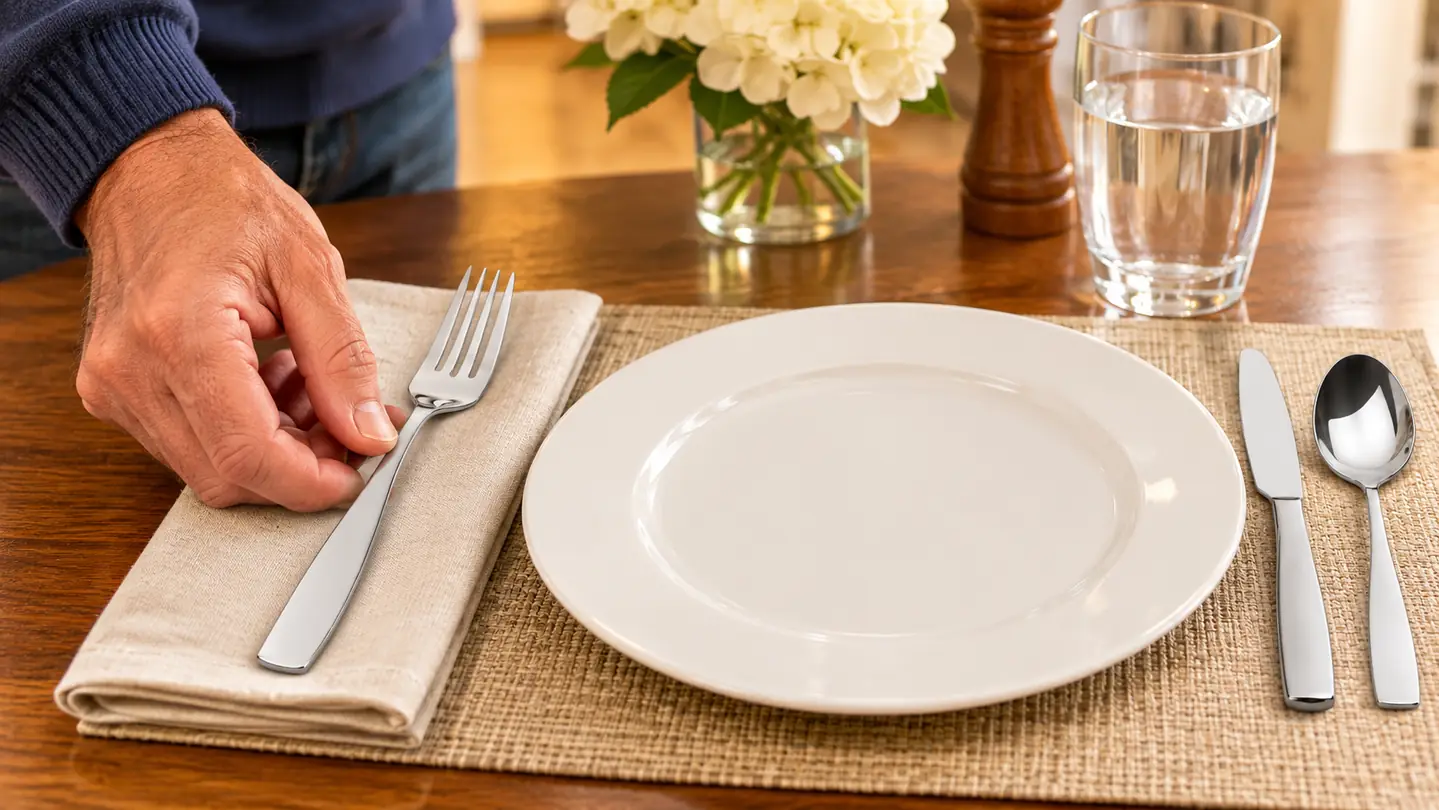
I taught home economics for twenty-nine years, and I still teach it every Sunday in my dining room. Fork on the left. Knife on the right with the blade facing the plate. Spoon beside the knife. Napkin folded at the left, and if you want to be particular, the fork goes on the napkin. My grandchildren set this table with these pieces because the flat handles give small hands something to hold and there is no pattern to line up wrong.
That sounds like a small thing until you have watched a seven year old try to square an ornate handle with the edge of the table and lose confidence halfway through. A flat handle lines up with the table edge by itself. The smooth edges mean nothing catches on a napkin or on a little finger. The set teaches the lesson along with me, which is the best kind of teaching aid there is.
There is one more thing, and it is the part I did not expect. Because the pieces match, the children can count. Twelve dinner forks, twelve salad forks, and a child who has to lay out eight places has to do arithmetic to get there. My youngest granddaughter now sets eight places without being asked twice, and she checks her own work before she calls me in. I am not sure the flatware deserves the credit, but it certainly does not hurt.

The Tradeoffs I've Learned to Live With
The handles are flat and plain, and that is a choice you either want or you do not. My mother's wedding silver had a pattern you could read across the room, and there is a part of me that misses it at Christmas. The Mikasa Satin Loft reads modern and quiet. Against a plain white plate and a linen napkin it looks exactly right. Against my grandmother's china it looks a little young. If your table is formal and old fashioned by design, this set will look like a guest who dressed for a different party.
Sixty-five pieces take up room. I keep the everyday forks and spoons in the kitchen drawer and the rest in the glass-front hutch, and I move them back and forth more than I would like. A household of two that never entertains twelve people should think hard about the size before ordering. And as I said, twelve settings is twelve. Fourteen at Thanksgiving means two people eat somewhere else, or off the older forks.
Storage is worth spelling out in inches, because I did not think it through before the box came. The butter knife and the dinner fork together fill the better part of a twelve inch drawer divider, and my kitchen drawer had four dividers in it and only two that were deep enough. I ended up buying a small wooden caddy for the hutch to hold the salad forks and the extra spoons, and it sits on the second shelf behind the good glasses. If your drawer is tight, plan where the overflow goes before the box arrives, not after.
The satin sheen is not the bright gleam of a mirror polish, and it will not pretend to be. It is a soft, even finish that looks tidy on a weekday table and slightly casual on a holiday one. I have decided I prefer that. A table set with too much shine can feel like a photograph instead of a dinner, and I would rather have the dinner.
What I Liked
- Twelve matching place settings from one box, so the card table matches the big table
- 18/10 stainless with higher nickel content, and no rust spots after months of dishwasher cycles
- The satin finish hides the small drawer scuffs a mirror polish would show
- Smooth flat handles are easy for grandchildren to hold and to line up with the table edge
- Dishwasher safe, and it comes out clean in one load
- Balanced in the hand without feeling heavy, even for small hands
Where It Falls Short
- Flat plain handles read modern, which can look young against formal patterned china
- Satin will hold a water spot if a piece air dries, so I towel dry before holidays
- Sixty-five pieces need real storage space, more than one kitchen drawer
- Service for twelve still leaves you short when the holiday crowd runs to fourteen
Fourteen people, two tables, and not a mismatched fork in the room. That is what I wanted, and that is what I got.
Who This Is For
Buy this if your table has grown past your flatware drawer. If you host a Sunday dinner or a holiday with two tables, and you are tired of sorting mismatched pieces before people arrive, twelve settings out of one box solves a problem nothing else on your list solves. It is also for the household teaching children to set a table, because plain, sturdy, matching pieces are easier to learn on than anything with a pattern. And it is for anyone who has pulled a rusty fork out of the dishwasher one too many times and decided they are finished with that particular humiliation.
Who Should Skip It
Skip it if your dining room is set in a formal, old fashioned style and you want flatware that answers to the china and the crystal. Skip it if your household is two people and a guest now and then, because sixty-five pieces will be a storage problem more than a help. Skip it if you refuse to towel dry before a holiday, since satin will spot and it will annoy you. And skip it if you want a pattern with some ornament to it, because this set is deliberately plain and it is not going to change.
If your table has outgrown your drawer, this is the set that ends the counting
Sixty-five pieces, twelve settings, 18/10 stainless, dishwasher safe, and months of my Sunday dinners behind it. It has already handled one fourteen person Thanksgiving without a mismatched fork in the room.
Amazon Check Today's Price on Amazon →