

Every year around the second week of November, my phone starts ringing with the same three questions. Where does the salad fork go. Does the blade face in or out. And does any of it actually matter.
The folks asking are not careless. They have set a thousand weeknight tables and then been handed a linen cloth and a twelve-person guest list and realized the rules changed somewhere along the way. I taught home economics in Bentonville for twenty-seven years, and I have set a formal table in this house for close to forty. Here is the short version: it is not complicated. It is a sequence. Learn the sequence once and your hands will finish it while your mind is on the roast.
One more thing before the steps. The flatware does half of this work for you. I keep a full service for twelve behind the glass doors of the hutch, and the set that comes out for company and for every holiday is the Mikasa Satin Loft, sixty-five pieces in 18/10 stainless steel. It comes out because it is complete, not because it is fancy. A table reads as formal when every place is identical and nothing is missing. A partial set is where most home tables quietly fall apart, and no amount of folded napkins covers for it.
Twelve places, all matching, nothing missing
Sixty-five pieces of 18/10 stainless steel from Mikasa, service for twelve, satin finish, dishwasher safe. When every seat has to match, this is the set that makes it possible.
Amazon Check Today's Price on Amazon →Step 1: Clear the table to bare wood, then lay the foundation
Start with nothing on the table. Not the centerpiece, not the salt and pepper, not the pile of mail that lives there the rest of the week. You cannot center a setting on a table that already has something off-center on it, and if you try, you will spend the next hour fighting a battle you created yourself. Clear it, wipe the wood down, and let it dry before anything else goes near it.
If you are using a cloth, put a flannel pad or a felt protector underneath it first. Then iron the cloth and lay it on folded, opening it out over the table rather than dragging it across, which stretches the weave and leaves the corners slightly off square. Pull it straight from opposite corners, not from the sides. It takes two minutes and it is the difference between a table that looks prepared and a table that looks rushed.
A cloth should hang about twelve inches, or down to the seat, on every side. One that is two inches short at the ends looks worse than no cloth at all, because the eye catches the gap before it catches anything else. If your cloth does not fit this table, use placemats and let the wood show. A bare polished table with good placemats is a correct formal table. A cloth that does not reach is not, and no guest will tell you so.
Step 2: Set the plates first, because everything else is measured from them
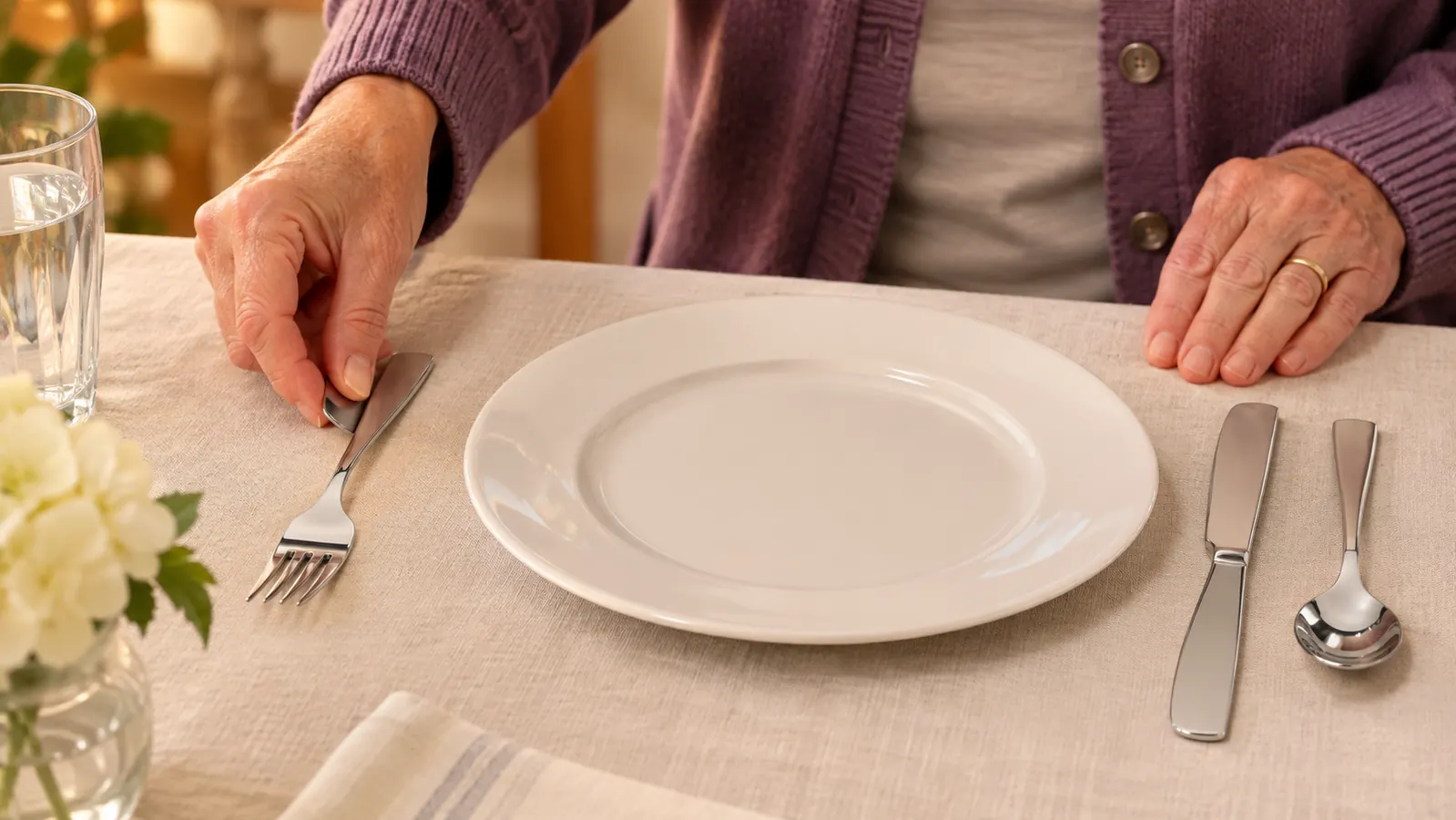
Every other piece on the table is placed in relation to the plate, so the plate has to be right before anything else goes down. Set it one inch back from the edge of the table, which is roughly where your fingertips land when you sit and let your hand fall. Not on the edge, and not so far in that the guest has to reach. One inch is the number, and it is the same number at every seat.
Center each plate on the chair, not on the table. Tables are not always square to the room and chairs are not always evenly spaced, and the chair is what the guest actually sits in. If you center on the table and the chairs are off, every setting will look slightly drunk from the doorway. Look up at the chair back, set the plate, look up again, and move on.
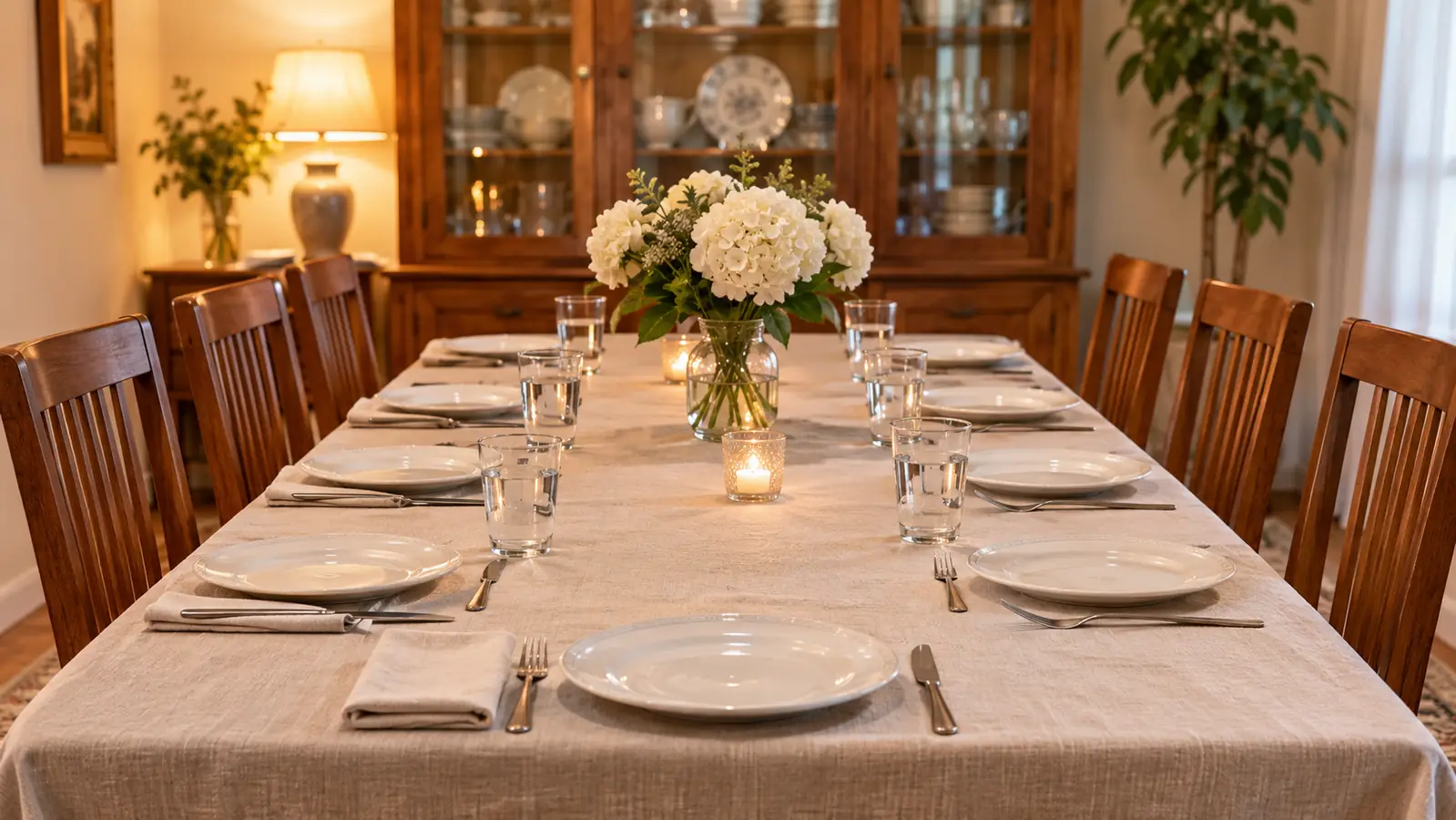
Space the settings at least fifteen inches apart, and twenty-four if you have the room. My oak table seats eight with both leaves in and six without them, and at Thanksgiving a card table goes at the end to take us to twelve or fourteen. My advice is to count your seats out loud before you set a single fork, and count your pieces while you are at it. Finding out at the seventh plate that you only have six dinner forks is a hard way to learn why a full service for twelve matters.
Step 3: Forks on the left, working from the outside in
The dinner fork goes directly left of the plate. If salad is served as its own course before the main, the salad fork goes outside it, farther from the plate. That is the whole rule, and it explains every place setting you have ever looked at across a restaurant table: the piece you pick up first sits farthest from the plate, and you work your way inward as the meal goes on. Once you see it that way you stop memorizing and start reasoning.
Never put more than three forks at one place. If your menu genuinely calls for a fourth, the menu is the problem and not the table. Serve the oyster fork on the plate with the oysters, or skip the course. A crowded left side is the fastest way to make a formal table look anxious.
Line the fork handles up with the bottom edge of the plate, not with the edge of the table. Everything on the left should sit on that same line, and that line should be the same distance from the table edge at every seat. It is the detail that separates a table that looks set from a table that looks thrown together, and it takes about four seconds per place once it becomes a habit. Then step back and look down the row of handles. They should read as one line.
The whole of formal etiquette fits in one sentence. The piece you pick up first is the piece farthest from the plate. Everything after that is arithmetic.
Step 4: Knife against the plate, blade turned in, spoons beyond it
The dinner knife goes directly right of the plate, close enough to touch it, with the blade facing the plate. Always the plate. Not the guest, not the room, not the window. A blade turned out is the most common mistake I see on home tables, and it is the one that makes a setting look wrong to anybody who was taught properly, even if they cannot tell you exactly why. It is the equivalent of a crooked picture frame. Nothing is broken, but the eye keeps going back to it.
Spoons go to the right of the knife, working outward in the order they will be used. The soup spoon is the one farthest from the plate, because soup comes before dessert. If dessert is served at the table, lay the dessert spoon and fork above the plate, horizontal, spoon above the fork with the bowl pointing left. If dessert is already plated in the kitchen, leave both of them off entirely. An unused piece is not elegance. It is clutter with good manners.
If you use a bread plate, it goes at the upper left, with the butter knife laid across it and the blade toward the center of the plate. Plenty of home hostesses skip the bread plate for a seated dinner and pass the basket instead. That is fine, and I do it myself most Sundays. Just do it the same way at every seat, because a table where some guests have a bread plate and some do not will start a quiet conversation you did not plan.
Step 5: Glass above the knife, napkin on the left, then walk the table
The water glass sits at the tip of the dinner knife, an inch or so above it. Wine goes to its right and slightly toward the center of the setting. Two glasses are plenty for a family dinner. Three is a statement about the hostess rather than about the meal, and I have been guilty of it.
The napkin goes to the left of the forks, folded with the open corner toward the plate, or folded and laid on the plate for a very formal dinner. Both are correct and I have used both. Pick one and use it at every seat, because a table where half the napkins are on the plate and half are beside it looks like two different people set it. Cloth napkins, pressed, if you have them. Paper is for Tuesday.
Then stand at the head of the table and look down it with one eye closed. You are checking two things: that the plate edges form a straight line, and that every setting has the same pieces in the same order. Fix the one that is off, pour the water, and pull the chairs out a few inches so guests can get in without dragging them across the floor. Then leave the room and go finish the gravy. The table is done, and it took you less time than the pie.
Place cards are worth the trouble at anything over eight people. Write them yourself in a plain hand and set them on the napkin, and seat couples apart rather than together. Nobody at a long table wants to spend two hours talking only to the person they rode in with, and a small card saves everyone the awkward shuffle at the door.
What Else Helps
Set the table the night before. A formal table does not care what time it is. Lay it out after supper, drape a clean sheet over the whole thing to keep the dust off, and spend the next morning on the food. Every holiday I have hosted went smoothly for exactly this reason, and every one that went sideways started with me hunting for the gravy ladle at four in the afternoon with flour on my hands.
Give the grandchildren jobs. My youngest granddaughter sets the forks now and checks the blades behind me, and she takes the work seriously because I handed it to her at seven and did not take it back. Children learn a table by setting one. Have them count the pieces out loud as they lay them, and let them carry the serving pieces to the sideboard one at a time. They will remember it at their own tables, and they will remember who taught them.
Keep the serving pieces off the table. A formal table needs room around the plates, and platters crowd it. Put them on the sideboard or the kitchen counter and pass from there. The same goes for salt and pepper, which belong between the settings, one pair for every two or three guests, not clustered in the middle where nobody can reach them without leaning across somebody's dinner.
Pay attention to what the flatware is made of, because you will be washing it for the next thirty years. The Mikasa set is 18/10 stainless, which means the nickel content is high enough to hold up against rust and corrosion, and mine has gone through the dishwasher after every holiday dinner since it came into this house. The satin finish and smooth, flat handles resist fingerprints, which sounds like a small thing until you have spent an evening looking down a table full of smudged handles.
Light the candles before anyone sits down, and put them where they will not blow into somebody's face. Keep them low and unscented near the table, because scent belongs to the food. Then turn the overhead light down and leave the lamps on across the room. It is the least expensive thing you can do to a table, and it does more for the evening than the china does.
Set it once, then set it every holiday for thirty years
The Mikasa Satin Loft set: sixty-five pieces, service for twelve, 18/10 stainless steel, satin finish, dishwasher safe. Twelve matching places is the part of a formal table you cannot improvise.
Amazon Check Today's Price on Amazon →