

The first time I set MAONAME gold chargers around my oak table, my youngest granddaughter asked why the plates had a little fence around the edge. That fence is the reef rim, and it is the reason these chargers do something a plain disc cannot. I taught home economics to seventh and eighth graders in Bentonville for thirty-one years, and I have set a great many tables in that time, at school and at home. Most of the chargers I have owned were flat, thin, and forgettable. These are not.
I ordered this set of six in the fall, before the holidays, and they have been on my table nearly every Sunday since. My husband Walt does the dishes after Sunday dinner, so he has an opinion about them, and I will get to that. What follows is not a first-impression review. It is what I can tell you after a fall and a winter of family dinners, two holiday meals with twelve to fourteen people in the house, and a good many ordinary Tuesday nights when I set the table for no better reason than that I wanted to.
The Quick Verdict
A substantial charger that holds a full dinner plate with room to spare and came through a season of Sundays without a chip. Hand wash only, and the low spots in the rim want a brush now and then, but the table looks finished with them on it.
Amazon Check Today's Price →Six chargers that changed how my Sunday table reads
Thirteen inches across, thick enough that a dinner plate sits down inside the rim, and textured so the edge catches light instead of lying flat. If your table has been missing that last finished layer, start here.
Amazon Check Today's Price on Amazon →How I've Used Them
They live in the lower cabinet beside the china hutch, stacked six high, and they come out every Sunday. My table seats eight with both leaves in and six with them out, so in ordinary weeks the chargers go on all six places and the two end settings get the everyday plates alone. I mention that because it took me one Sunday to learn that a table where only some settings have a charger looks like a mistake rather than a choice. Six is the right number for my everyday table. It is not enough for Christmas.
One January Sunday I set them out with my mother's white ironstone and a plain linen cloth, and my daughter said the table looked like a photograph from a magazine she could not name. Nothing else on that table had changed. That is the thing about a charger. It is the only layer that can change the whole table without replacing a single dish.
What I have asked of them is not gentle. Thanksgiving, Christmas, a birthday supper for my son in February, and every Sunday in between. They have held bowls of soup, salad plates, and my heavy stoneware dinner plates, which are not light. They have been carried from the kitchen to the dining room in stacks of three, which the box does not recommend and which I do anyway.
For the holidays I use them on the six places at the main table and let the card table at the end go without. Twelve to fourteen people is a crowd, and that card table already looks like what it is. Nobody has ever complained. I have thought about ordering a second set so the whole room matches, and I may yet, but I want to be honest that one set of six has limits.
What the Reef Rim Does for a Table
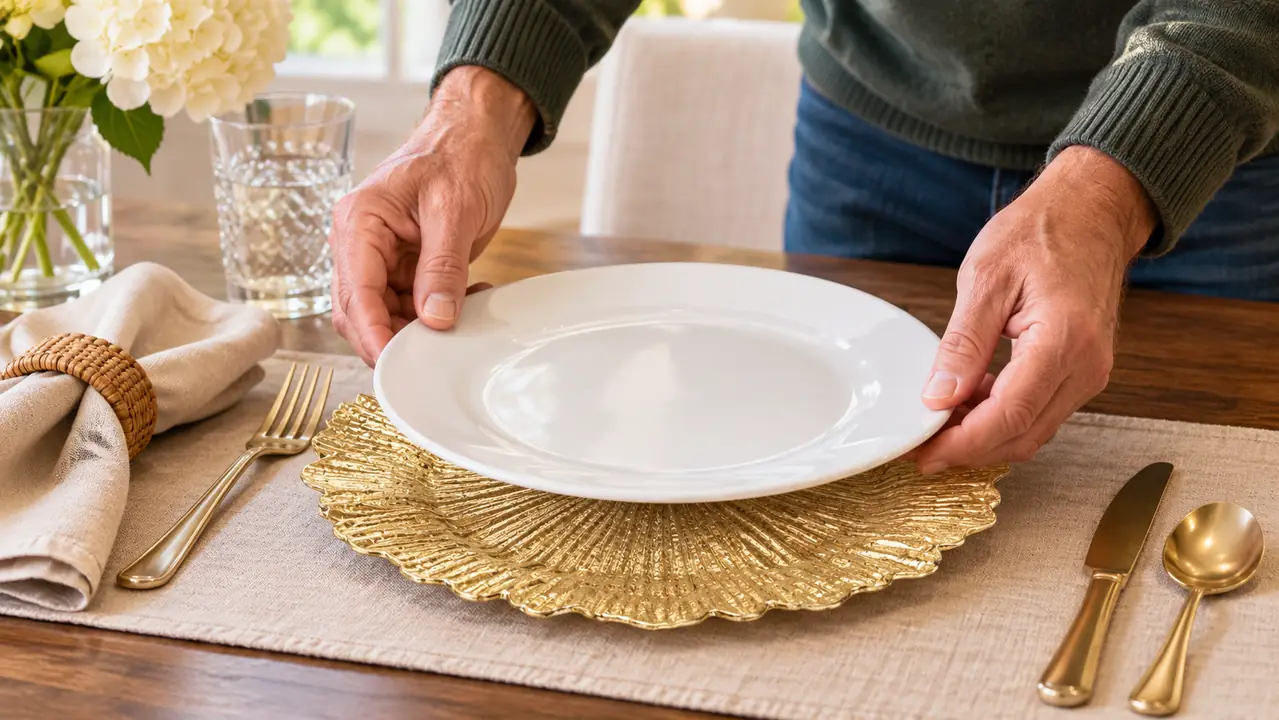
A plain charger is a colored circle. It frames the plate, it adds a layer, and if it is thin it also announces itself as a piece of plastic the moment a fork touches it. The reef rim changes that. On this round plate the pattern runs around the outer edge in a raised, ruffled band, and because the band stands up from the surface, it throws a small shadow. That shadow is what your eye reads as depth. On a white tablecloth, with white plates on top, that shadow is doing most of the work.
The edge is leveled, according to the listing, which I take to mean the rim sits flat against the table instead of rocking. In practice none of the six wobbles, and I have set them on a bare oak table, on a quilted runner, and on a linen cloth that refuses to lie flat. The bottom is smooth and has not marked the finish on my table. I checked, because I am the sort of person who checks.
The listing also mentions a food safe treatment, and I will tell you what I tell my grandchildren: the food goes on the plate, not on the charger. A bowl of soup sits down inside the rim, and the charger stays a frame. That is what it is for, and it does that job well. The thick border is what makes it work, because it holds the plate up off the cloth just enough to matter.
The finish is gold, and it is a warm gold rather than a bright one, closer to the color of an old brass candlestick than to a new piece of jewelry. Under candlelight it goes quiet and soft. Under the overhead light at two in the afternoon it looks like what it is, a molded piece with a metallic coating. I do not say that to talk you out of them. I say it because a charger is a stage set, and a stage set is meant to be seen from the seats, not from six inches away.
Where the pattern earns its keep is in the way it hides handling. A smooth metallic surface shows every fingerprint and every swirl from a dish towel. The raised reef breaks up the surface, so the smudges do not gather in one readable place. After a dinner the rim looks much the same as it did before the dinner. The flat center is where you will see marks, and the flat center spends the evening under a plate.
The Thirteen-Inch Question
Thirteen inches across is large. My everyday dinner plates are ten and a half inches, which leaves an inch and a quarter of charger showing all the way around. That is the proportion you want. Too little reveal and the charger looks like a sizing mistake. Too much and the plate looks lost in the middle of a platter. At thirteen inches, a ten inch plate, a ten and a half inch plate, and a salad plate all sit correctly.
The thickness is listed at 0.78 inches, and that number matters more than it sounds. A thin charger disappears under a full dinner plate, and the whole point of the thing is to be seen. This one has a thick border that sits proud of the table, so even with the heaviest stoneware on top, a ring of rim shows all the way around. My soup bowls sit down inside that ring nicely. The listing recommends these for soup and salad, and that is right.
One caution. Thirteen inches is wider than some placemats and wider than the space between settings on a small table. With both leaves in, my six chargers leave room for flatware and a glass and no more. Eight would be tight. If your table is narrow, measure before you order, because six of these take up more room than six dinner plates do.
Six chargers, fourteen people in the house, and not one chipped edge by the end of Christmas dinner. That is most of the review, really.
Washing, Stacking, and Storing
The MAONAME chargers are hand wash only. The listing says so plainly and I would not test it. The reason is not a mystery. Heat and a harsh detergent will dull a metallic finish, and a dishwasher basket will bang a thirteen inch disc against everything else in the load. I wash them in the sink with a soft cloth and a little mild soap, rinse, and dry them straight away with a towel. It takes about four minutes for six. Walt has it down to three.
If you leave them to air dry you will get water spots on the flat center. On the rim they are invisible. I dry them because I am the way I am, but I want to be fair. The spots come off with a dry towel and they do not etch. This is not a finish that fails. It is a finish that shows you where you were lazy.
Stacking is where the weight helps. The set is 4.6 pounds, so about twelve ounces each, heavy enough to feel like something in the hand and light enough that a stack of six is not a chore to carry. I stack all six in the cabinet with a felt pad between the top two, mostly because that cabinet is tight. They have not warped, and the rims have not flattened under the stack, which is more than I can say for the thin chargers I owned before.

Where They Show Wear After Many Dinners
After a season, here is what I can see. The MAONAME rims still catch the light the way they did in October. No chips, no cracks, no peeling at the edges, and no pale spots where the coating has worn through. That last one is what I expected and did not get. The place where I can find wear is on the underside, where the six of them rub against each other in the stack, and it is a dulling rather than a scratch. Nobody at the table is looking at the underside.
The honest complaint is dust. The reef pattern has low spots, and low spots hold dust between dinners if the chargers sit out on a table or an open shelf. Mine live in a closed cabinet, so it is a small thing. A friend keeps hers on a plate rail in the dining room, and she dusts them with a soft brush once a week. That is the trade for a textured rim. A smooth charger wipes clean in one pass and then looks like nothing at all.
The other thing I notice is that they are plastic, and plastic sounds like plastic. Set a fork down hard on the charger between courses and you will hear a click that a ceramic charger would not make. It is a small sound and the room is usually loud enough to cover it. I mention it because you will hear it the first time and wonder, and then you will stop hearing it.
What I Liked
- Thirteen inches wide, so a ten inch dinner plate still leaves a full ring of rim showing
- The raised reef rim throws a shadow that reads as depth on a white cloth
- Came through a season of Sunday dinners and two holidays without a chip or a peeled edge
- About twelve ounces each, substantial in the hand without being heavy to carry
- The pattern hides fingerprints and towel swirls that a smooth metallic surface would show
Where It Falls Short
- Hand wash only, and air drying leaves water spots on the flat center
- The low spots in the rim collect dust between uses
- Sold in sets of six, which is short of a twelve place holiday table
- Plastic rings slightly when flatware is set down on it
- Thirteen inches is wide for a narrow table or a small placemat
Who This Is For
This is for the woman who sets a table on purpose. If you have a hutch full of plates you use twice a year and you want the table to look like an occasion without buying another set of china, a charger is the smallest change you can make and the one guests notice first. I have watched people run a finger along the rim before they sit down. They do not do that with a plate.
It is also for the hostess who feeds a crowd and wants the table to look finished without spending the afternoon on it. Six of these on the main table, the everyday plates at the card table, and the room reads as one table. That is a small trick and it works every time I have tried it.
Who Should Skip It
If you want to put them in the dishwasher, skip them. Hand wash only is not a line printed to protect a lawyer. A metallic coating and a hot drying cycle are not friends, and you will be disappointed by February. The same goes for anyone who wants a charger she can leave on an open shelf for a month and wipe with a paper towel. The reef rim is textured, and texture holds dust.
If your holiday table seats twelve and you want every place to match, plan on two sets or look at a set of twelve. One set of six will not do it, and I would rather tell you now than have you find out on the Wednesday before Thanksgiving. And if your plates are larger than eleven inches, measure first. Thirteen inches of charger under a twelve inch plate leaves almost no reveal, and the whole effect disappears.
If your table is one layer short of finished, this is the layer
Six MAONAME chargers, thirteen inches, hand wash only, and mine still look like October after a fall and a winter of Sundays. Set one place with it and you will see the difference before the plates come out of the kitchen.
Amazon Check Today's Price on Amazon →